While I wait excitedly for next week’s photo shoot with my first volunteer model, words that encapsulate this new project continue to formulate in my head:
THE NUDE has been admired, studied, and discussed for over two millennia, having made its noble debut in sculpture in Ancient Greece. During the Renaissance and later, painters took up the subject with fervour, but in 1838 the invention of photography enabled artistic explorations that had never before been possible.
Oil Painting, 1814, by Jean Auguste Dominique Ingres
Original by Myron, 440-450 BCE, Roman copy from 2nd c. CE
Salted paper print from glass negative, Franck–François–Genès Chauvassaignes
In recent times, attitudes about the female body have been shaped by the overt sexualization [objectification] of women and girls in advertising, media, and the entertainment industry. Consequently, women have internalized unhealthy societal constructs regarding beauty and desirability, leaving no room for flaws, wrinkles, or aging.
The reality is that natural signs of aging have been consistently maligned [especially for women] since the advent of corporate advertising in the 1950s and 60s, with its endless brands of facial creams, hair dyes, and other age-defying products. Cosmetic surgery and photoshopped images in glossy magazines underscore our obsession with maintaining the outward appearance of youthful immortality. As a consequence, we are deeper in denial, more insecure, and more dysfunctional than ever as a society.
My intent with this project is to challenge contemporary notions of feminine beauty and the fallacy that it is the sole domain of the young and nubile. My subjects are mature women – mothers and grandmothers – with no experience in front of a camera. The poses are seated, and all compositions are from the neck down with special attention paid to the placement and character of the hands (which are closest to the camera’s lens). The body therefore becomes secondary, offering only partial views of itself with a softness resulting from the shallow depth of field. By not photographing their faces, the women are more relaxed and able to be themselves. Their humanity, strengths, and frailties are communicated through their hands.
In creating and editing my images, I explore shape, texture, and composition as a vehicle to a meaningful narrative. There is no shame in aging because the experience and wisdom that accompany it are truly wondrous and beautiful gifts. Besides, we are so much more than our outer shells.
In viewing the body at its barest and most honest, we are given a mirror with which to contemplate our own vulnerabilities, and ultimately the impermanence and mortality that we all share. My approach to the nude is considered and modest. It does not push the boundaries, nor does it demand to be “in your face.” It is quiet and meditative. It transcends the carnal and hints at deeper ponderings.
The famous Polka Dot House still standing with the decorated tree beside it
Yesterday, my friend Adele and I visited The Heidelberg Project in Detroit. Situated in one of the most economically depressed neighbourhoods in the United States, I wasn’t prepared for the impact it would have on me. Before I talk more about it, here’s a brief description from their website:
The Heidelberg Project is art, energy, and community. It’s an open-air art environment in the heart of an urban community on Detroit’s East Side. Tyree Guyton, founder and artistic director, uses everyday, discarded objects to create a two block area full of color, symbolism, and intrigue. Now in its 27th year, the Heidelberg Project is recognized around the world as a demonstration of the power of creativity to transform lives.
The Heidelberg Project offers a forum for ideas, a seed of hope, and a bright vision for the future. It’s about taking a stand to save forgotten neighborhoods. It’s about helping people think outside the box and it’s about offering solutions. It’s about healing communities through art – and it’s working!
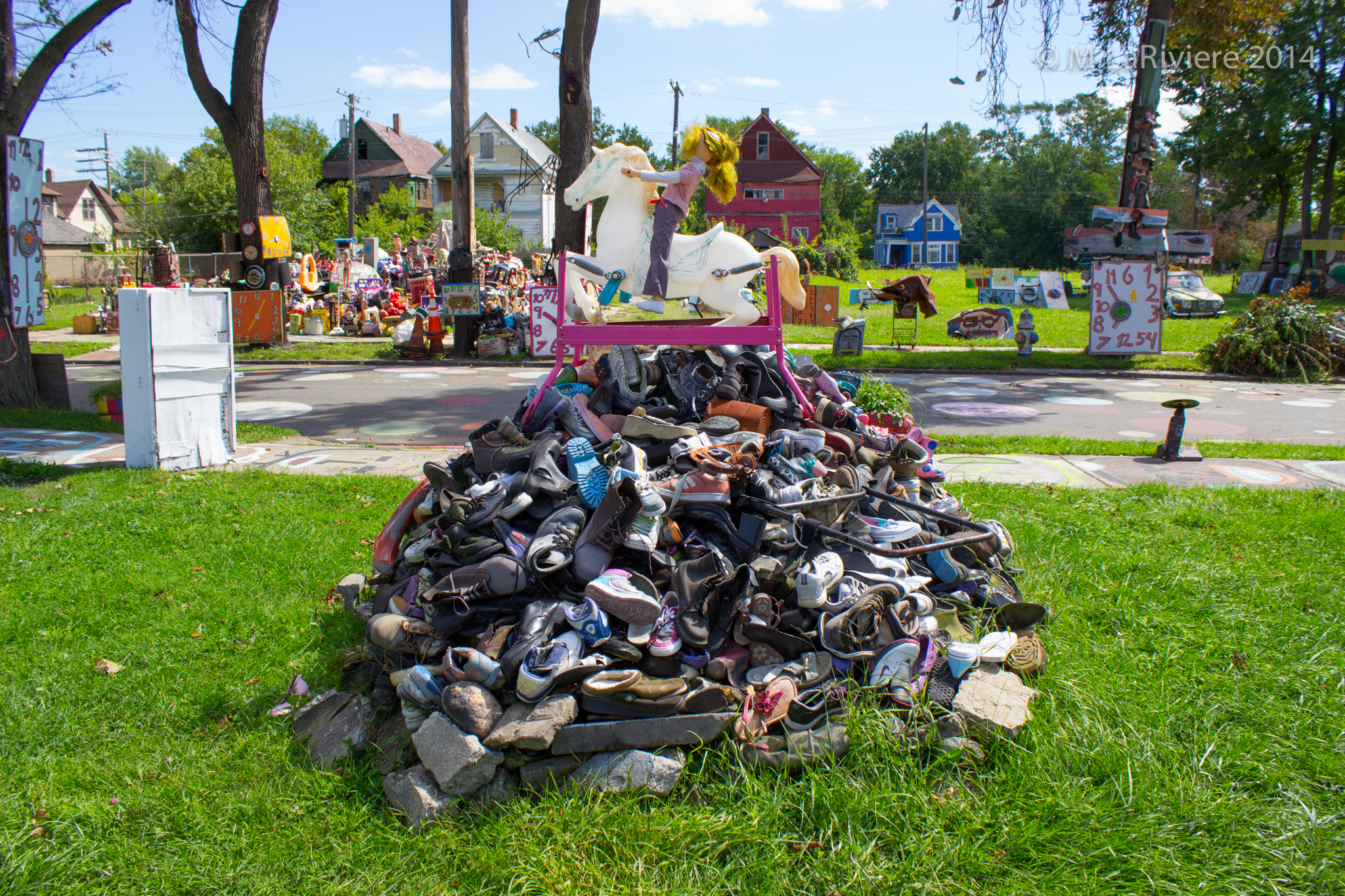
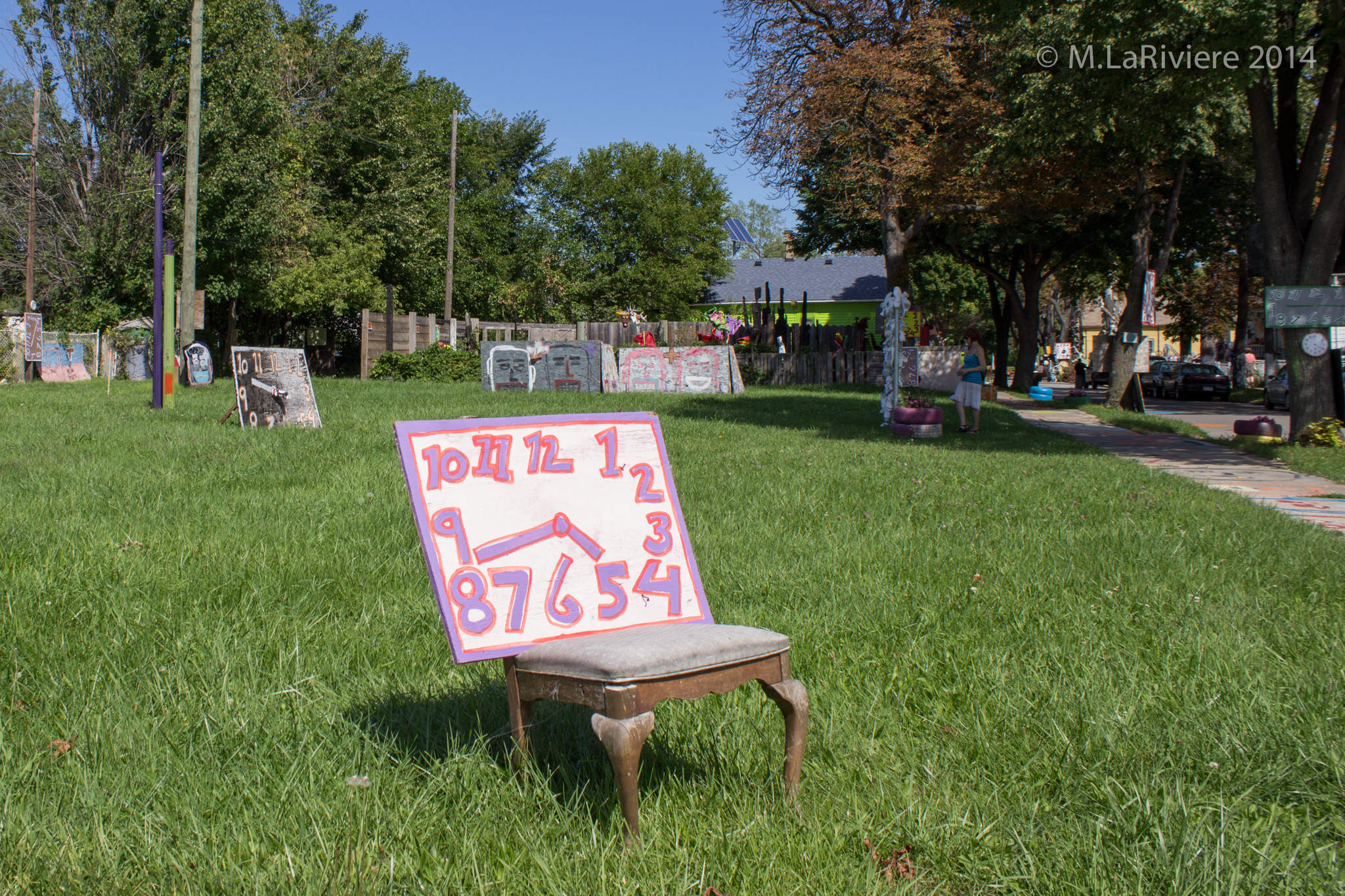
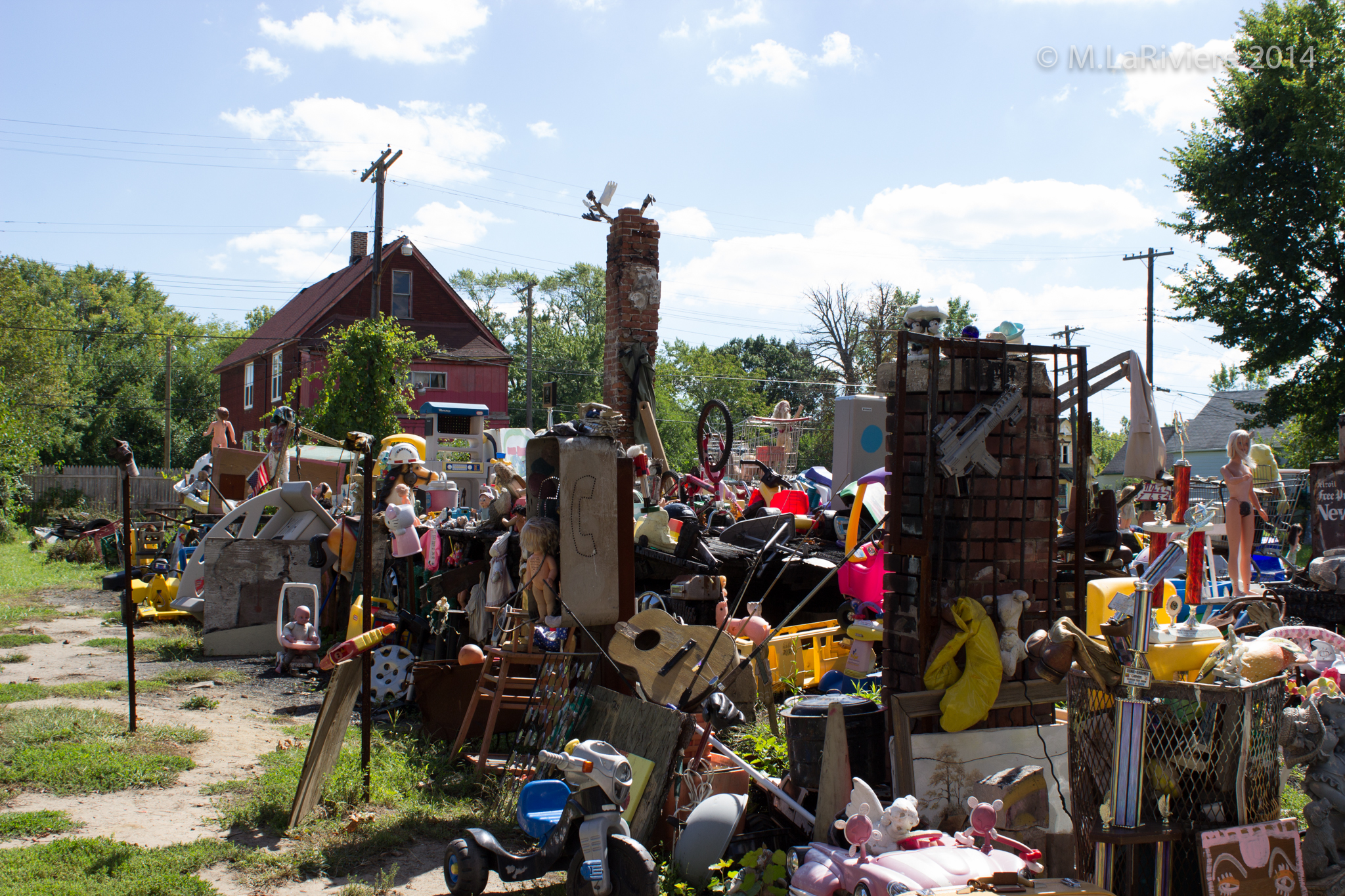
Upon arrival, I was overwhelmed with what initially looked like undecipherable clutter. The first thing that struck me was the sheer number shoes. They were part of almost every installation – thousands of shoes. The second thing I noticed was the clocks strewn about from one end of the project to the other, many with their numbers out of order. The piece that hit me the hardest was the old oven full of crusty shoes. It was positively unsettling, and immediately brought to mind Auschwitz and the horrors that happened there. Obviously there is no comparison, but what happened to Detroit is a colossal human tragedy.
One of the more disturbing pieces I saw that day
Anyway, it took a while to absorb what I was seeing – to make sense of it and the intensity of its message. In fact it didn’t fully sink in until after I got home. On the surface, the art in that two-block stretch appears whimsical, decorative, and chaotic all at the same time. But what about all those shoes? At the very least, they are poignant reminders of the decimation of Detroit’s population (from nearly 2 million down to its current 700,000). Miles and miles of once vibrant neighbourhoods are now largely abandoned, burned out, and forgotten. Those shoes are testimony that people – lots of people – lived, loved, and worked there at one time. Which brings us to the clocks.
A mound of shoes crowned by a child’s riding horse and a doll astride itClocks and other installations on an empty lot on Heidelberg Street
The references to time are inescapable, and multiple interpretations are possible. Combined with the shoes, the deliberate juxtaposition suggests a symbolic and deeper reading. Clichéd expressions come to mind. Time stands still. We’re out of time. The clock is ticking. Time is running out. The times they are a changing. Time on your hands. There’s no time like the present. All in due time. Time heals all. We can each draw our own conclusions – HP is certainly a thought-provoking place.
A memorial to all the people who lived, loved, and worked in Detroit
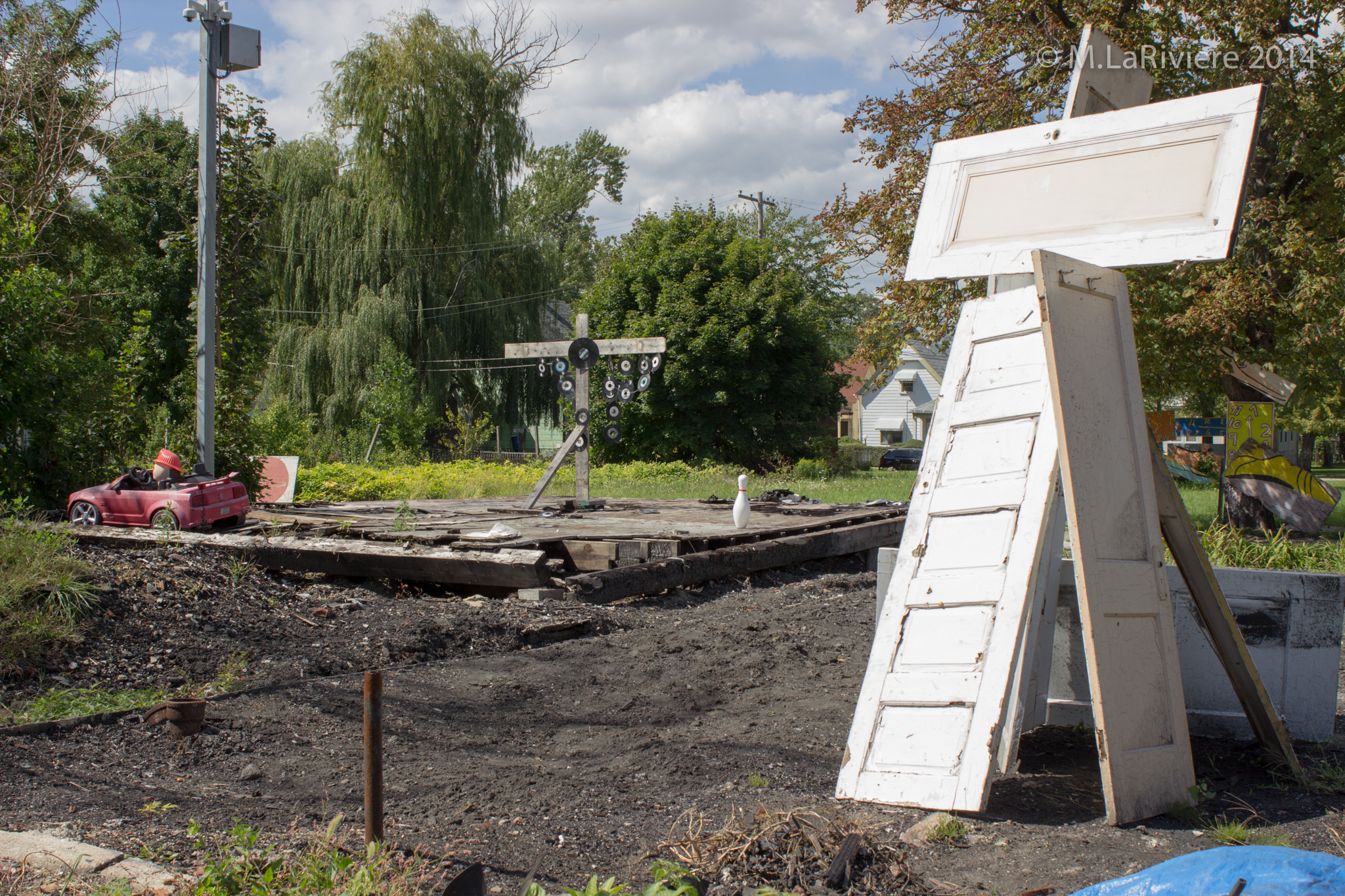
Above all, The Heidelberg Project is about optimism and taking pride and ownership of your environment, especially when it is suffering under dire and desperate circumstances completely out of your control. Despite the controversies and criticism it receives – many refer to it as nothing more than piles of junk and trash – what I saw there is undeniably powerful. Sadly, HP faces many challenges. Apparently, five of the eight principle art houses have been destroyed by arsonists since 2013. Their charred remains have been turned into what can only be described as shrines to what once was. Nevertheless, the founders and volunteers invested in this project seem to take it as it comes and continue to work with what they have.
I’m guessing that the house foundation where the cross is is where the art house covered in vinyl albums once stood – another casualty of arsonThe remains of one of the torched art houses now converted into a shrine
A final word about Detroit – despite its history and current difficulties, the city is truly inspiring. Countless entrepreneurial pop-up businesses and grassroots community efforts are infusing the city with fresh vitality. People are relying less on the government and more on each other to improve the quality of their own lives. Adele and I were overwhelmed by the friendliness we encountered everywhere – first at the HP project; then near the Eastern Market searching for the Canadian Residency on Gratiot where renowned Canadian artist, Suzy Lake, is currently working; then in the Wayne State University area looking for the Motor City Brewing Works (a restaurant that Suzy recommended), and finally downtown while looking for the historic Guardian Building! People were friendly and generous.
I was born in Detroit, and lived there for the first five and a half years of my life. Of the many places I’ve lived in the past fifty years, although some were great, none have truly felt like “my place.” I saw a post on Facebook the other day that said something to the effect of, “Home is where your story began.” So… like an imprinted gosling, I’ve finally found my way back home, and it feels right. (I have to live in Detroit’s sister city, Windsor, for now, but it’s close enough for me.)
The Heidelberg Project attracts 50,000 visitors per year, including a young French couple from Switzerland that we met there yesterday. This kind of attention is very positive because it brings much needed tourist dollars to the financially ailing city.
One of many clocks
Side of the Polka Dot House
A few remaining houses in the neighbourhood
The remains of one of the torched art houses now converted into a shrine
Car hoods reminiscent of the domino effect
Heidelberg Street
Salvaged door installation
Car hoods, reminiscent of the domino effect
Car hoods, reminiscent of the domino effect
Interesting piece with charred house boards behind it from the rash of arsons.
The Polka Dot House surrounded by clocks and shoes
Car hoods
An old stove with a crushed globe of the world inside the oven
One of the remaining houses protected by a shoe fence
A fence strung with shoes
I consent to the use of my Heidelberg Project photos by the Heidelberg Project for promotional and educational purposes. Just give me a heads up guys.
The deeper I get into exploring what my DSLR can do, the more I learn – not just about the mechanics of the camera, but DIY tricks (that can substitute for expensive studio equipment), post-editing tips, the best websites, etc.
I subscribe to a couple of photography magazines and occasionally venture into forums for information, and one recommended site that keeps popping up is 500px. It’s an online community for serious photographers, where you can join discussion groups, learn from the pros, and have your work critiqued.
Well, last night I signed up and uploaded several photos. Things started happening fast! In addition to seeing hundreds of jaw-dropping images by world-class photographers, in less than eighteen hours I had over 750 views, dozens of likes and “favourited” images, plus some comments and questions.
What surprised me was that in the first hour, one image (not my favourite) skyrocketed up to the Popular Page because its ratings were booming (the one above on the left). I honestly didn’t think it was the best of the series. I uploaded several more images this afternoon, and the image above on the right took off. The levels are Fresh, Upcoming, Popular, and Editor’s Choice in that order. According to 500px, this kind of feedback is useful when shortlisting your best work for a portfolio. It’s good to have an objective opinion, so I would have to agree.
In conclusion, I’ve tried other sites and 500px comes out on top. The interface is clean, the galleries are attractively presented, and the image viewing quality is absolutely stunning. Here’s the link to my page so you can see for yourself.





 Michelle LaRiviere