Poetry vs. Smut

While I’ve been enjoying taking photos of bugs, flowers, and family with my new DSLR camera, the other night I returned to my Fine Arts roots. This yielded some interesting results and fresh ideas. Having spent six years in “art school” environments, life drawing and anatomy studies with nude models, art history, and feminist discourse surrounding the male gaze, etc., were everyday fare. Whether it be Michaelangelo’s David, or Manet’s brazen, and stark naked Olympia, we studied and wrote about it at length from a critical and academic point of view.

The human form has held fascination for artists for millennia, but the rupture, or disconnect for me occurred the first time that family saw my life drawings. The best way to describe it would be nervous giggles and incomprehension at my apparent obsession with “naked people” – naked women in particular. This inadvertently led to speculation about my sexual orientation, which still lingers to this day. Nevertheless, it became clear that although the nude is standard study in the art world, the average citizen (more cognizant of Playboy and pornography than of art history) has been seriously impacted by the overt sexualization [objectification] of women and girls in popular culture, media, and advertising. You could say that the nude is carrying around a lot of baggage. The territory is fraught with fear, loathing, embarrassment, misunderstanding, and sometimes censorship.

Still, I am drawn to the human form as subject, and despite my own acute awareness and sensitivity to the difficulties some viewers have with the nude in art, I proceed – delicately and attentively. To help clarify, I think it’s helpful to think in terms of poetry versus smut. A poem can evoke imagery that draws out emotion, sometimes even on a spiritual level, while smut is designed and intended to titillate the baser senses. To view a work of fine art as a visual poem, complete with meaningful narrative and symbolism, whatever that may be, can be an intensely personal and soulful experience if one is open to it.

In viewing the body (whatever body) at its barest and most honest, we are given a mirror with which to contemplate our own vulnerabilities, and ultimately the impermanence and mortality that we all share. My approach to the nude is considered and modest. It does not push the boundaries, nor does it demand to be “in your face.” It is quiet and meditative. It transcends the carnal and hints at other things.

Click here to view more images from this new series of work.

Blinded by Beauty: Before & After

Desktop

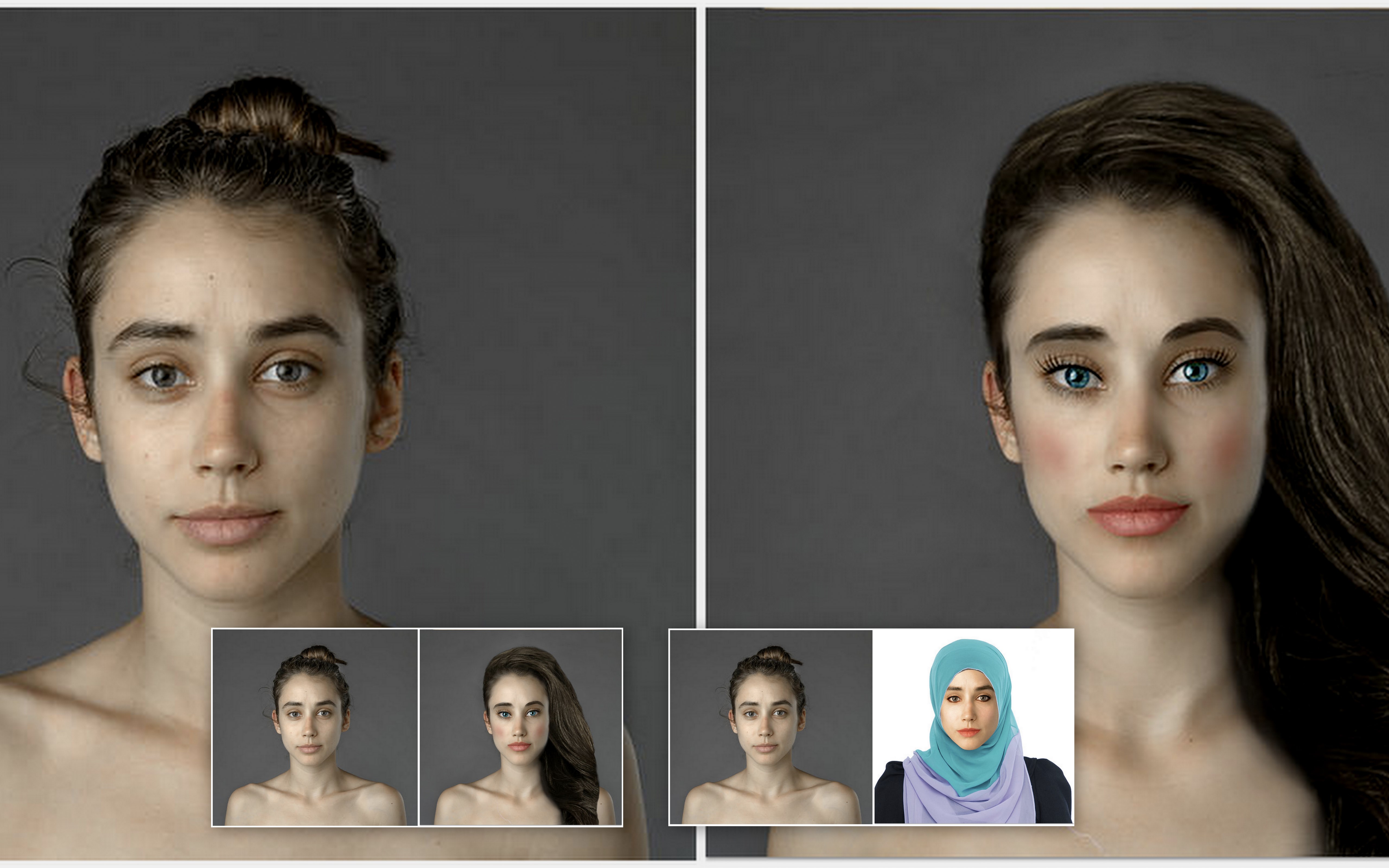
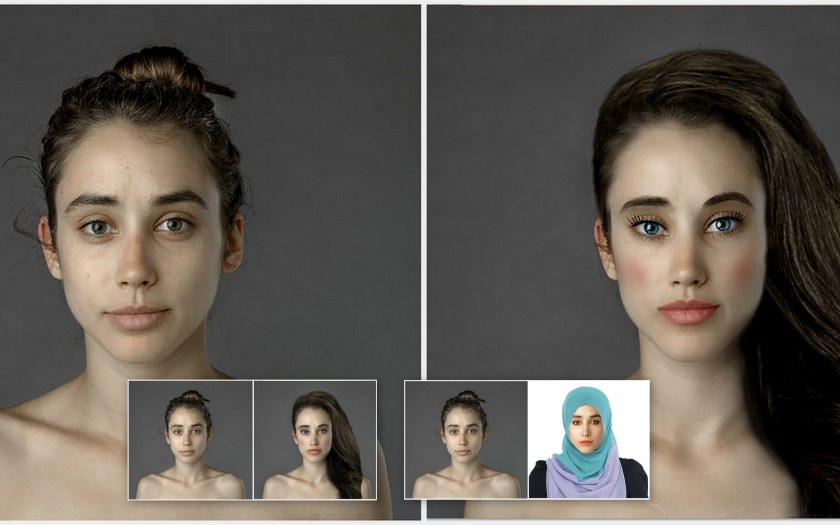
This morning a friend shared a Huffington Post article by Amanda Duberman about a project by Esther Honig, a human interest reporter, who sent a photograph of herself to photo-editors in over twenty-five countries. She asked them simply “to make me beautiful,” and through their photoshopping efforts she would examine the standards of beauty, and concepts of the “perfect woman,” to see how cultural values had affected the outcome. The results were stunning.

While my initial response to the amazing variety of images emanated from my artist self, a comment by a male friend about the article really got me re-thinking the thrust of her project. My friend stated flatly that make-up (both face paint and computer paint) was all the same. I re-read the article, which is when my cringe factor began to tingle, thus compelling me to write this essay.

First of all, a word about make-up. Make-up has been around since Egyptian times or earlier, so the desire to enhance and dramatize seems to be an inherent tendency in the human condition. That much is true.

However, the thing about “computer make-up” and “mannequinesk” alterations is that for decades young women have been bombarded from all sides with a fake, unattainable ideal as represented in the media, advertising, and the entertainment industry. Today, corporate exploitation of human frailties, the mindless obsession with celebrity idolatry, and the dangerous pursuit of everything artificial has caused a hysterical rejection of our “flaws,” and an epidemic of dysmorphic perceptions and attitudes about the natural human form and its outer appearance. Anorexia, bulimia, Body Dysmorphic Disorder, extreme plastic surgery – all betray a crisis of self, and a crisis of identity that has exploded in recent history.

In examining the array of images, I couldn’t help but observe that the American version of Honig’s face, featured in the Huffington Post, underscores our society’s current obsession with the infantilized woman (usually devoid of pubic hair) as a desirable sexual object. In any case, Honig appears undeniably pubescent in this doctored photo. A second American photoshopped image (on her website) is an unabashed rendition of Angelina Jolie as the model for idealized feminine beauty. These are obvious western constructs that I’m already familiar with and can easily identify. It would be interesting to be able to spot how the other images reflect different aspects of popular culture in their respective countries. And out of curiosity, I would especially like to know which images were shopped by men, and which ones were done by women. I suspect that a pattern would emerge suggesting possible gender bias or preferences in rendering the female face, but a controlled study group would be essential for this kind of research.

Nevertheless, I admit that viewing the Before & After gallery vis-à-vis the country of origin is intriguing. And I do applaud Honig’s personal growth and cultural awakening, her openness to “the concept of religion and custom, not just aesthetics,” her realization of how uneven her natural skin tone is. BUT the fact remains that her thesis is shallow, disappointing, and does nothing to address cultural stereotyping or the pressure on men and especially women everywhere to “measure up” in the beauty department somehow, some way. After all, foot binding, invented to achieve the coveted (albeit crippled and pus-oozing) lotus foot, was the pinnacle of Chinese status, beauty, and sexiness not so long ago. And let’s not forget the rib-cracking corsets with the 16-20 inch target waistline… but I digress.

What’s most frustrating is that she hints at the problem of “unattainable standards of beauty,” but then superficially glosses over it by stating, “when we compare those standards on a global scale, achieving the ideal remains all the more elusive.” She never says, just be yourself and forget the brainwashing you’ve been subjected to. She never wonders about women around the world and their struggles to negotiate imposed patriarchal values and standards. She never talks about the consequences of buying into the beauty myth or asks how we even got to his point. All of these things scream out to be examined and have everything to do with her project, but are ignored. This could not be better illustrated than by her failure to comment on the two American versions of her image discussed earlier. Even worse, how is it helpful or even acceptable to stereotype tastes and trends in different countries based on individual and subjective photoshopped ideals of feminine beauty in this day and age? If nothing else, it’s problematic.

Honig has missed a golden opportunity to dig beneath the surface and actually say something – that striving for artificial, exterior beauty (some cultures may be more afflicted than others) is a soul-numbing endeavour, where we as humans can never win, and all the while risking losing touch with the essence of our inner being, where our true strength and beauty resides. As Duberman concludes, perhaps the myth of a singular beauty norm has been dispelled (for whom I wonder), but nothing in her article or the project questions, educates, or enlightens. It saddens me to realize that Jean Kilbourne’s message in the Killing Us Softly series has been lost and trampled under the feet of new generations eager in their relentless quest for physical perfection.

In closing, I skimmed through enough of the extensive comment section of the article to get a sense of overall reactions to the Before & After project, which only served to prove my point. There was an overwhelming amount of criticism, scorn, and ridicule over the quality of the photoshopping and retouching, which tells me that most did not bother to skip over to Honig’s website to gather more information about the project, or to even ponder and reflect on her motives and the bigger picture. It was all about skill and appearances. Maybe if I dig a little deeper I might find a few kindred souls searching, like me, for actual meaning and discourse. I know you’re out there… somewhere.

Before & After by Esther Honig

Huffington Post Article by Amanda Duberman

Killing Us Softly 4 Trailer

Ray’s Daughter: The Diving Helmet – Part 2

IMG_3463_2Link:  The Diving Helmet – Part 1

My brother Bert is a sensitive soul, and I love him for it. Our father’s helmet has drawn us closer together these past months. Our conversations usually centre around building some kind of a stand for it: we discuss special designs, what it should be made of, for example wood versus metal, and sometimes there is weeping involved. I’m not sure if it’s over sadness at what’s been lost, or happiness at what’s been found–perhaps a little of both. He was two years old when the accident happened.

I’ve taken to calling the helmet Dad. I picked him up on July 14th–the day of yet another in a series of celebratory and emotional family reunions last year, this time at my uncle Nel’s in Detroit. Two of my dad’s brothers and his two sisters were there, as well as numerous in-laws, nieces, one nephew, and many old friends of his. What was special this time was that all seven of my grandparents’ granddaughters were together for the very first time, three having travelled from the west coast with their mother, Aunt Nancy.  Memère and Pepère would have been so pleased. It was quite a crowd!

Throughout that hot, overcast July afternoon, I was introduced over and over again as “Ray’s daughter,” which was quite surreal to my ears. But what struck me the most was the reaction each and every time — the person’s jaw would go slack, their eyes would brighten, and they all more or less said the same thing, “I knew your dad! He was such a great guy, and what a story-teller!!! I could have listened to his stories all day long!” For the first time I was seeing him as much more than the vague, ghostly “daddy” of my five year old self. He was also a loved, respected, and much cherished brother and friend.

At about three o’clock I pulled out my black portfolio containing the intaglio and lithographic prints of my father in his diving suit, and we gathered in the large gazebo where a ceiling fan quietly rotated above our heads. First I showed the copper plates and explained the etching process, then I described the printing process while pulling out each print and laying it on the table. My audience was rapt. At one point, an old friend of the family exclaimed, “Oh my God, that’s him!!! It’s him!!!” I ended this show-and-tell by giving prints to each of my father’s four siblings as thanks for their warmth and generosity, and later gave a special hand-coloured one to my uncle Mark who could not attend because he is ill and frail. I sure wish my three brothers could have been there, but as our ancestors have known for eons, stories are magical and build a life of their own in our imaginations. And I am after all, Ray-the-story-teller’s daughter.

Later that afternoon I went with my aunt Gisele and two cousins over to aunt Diane and uncle Keith’s place. Several weeks prior, the family had decided to move the helmet from my uncle Mark’s over to Keith and Diane’s garage in preparation for my arrival. Uncle Keith had improvised a stand for it in the middle of the floor. The garage door was wide open when we pulled into the driveway, and I was relieved that our view was obstructed by several parked vehicles. Other family had already arrived and there seemed to be a lot of people milling around, chatting and having a good time. I had spent many sleepless nights fantasizing about this day and decided to dash into the house to get a drink, while shielding my eyes from catching any accidental glimpses. The first moment had to be right.

I was a bit of a wreck so Aunt Diane offered me a margarita, and my cousin Shelley, grasping the situation, went outside and gently and lovingly prepared the way for me. When the yard was finally clear, I slipped outside and slowly walked up to the garage, and to my father’s helmet. This long anticipated moment was better than I had imagined (thanks to uncle Keith’s thoughtfulness). I knelt, and we were finally face to face. I’m not sure how much time passed, but all I can say is that it was very special.

That evening Dad crossed the old Ambassador Bridge back to Canada nestled in the back seat between my cousin Karen and I. The view was spectacular. Once in Windsor, my cousin Mark carefully transferred him to the front passenger seat of my car, and secured the seat belt safely around him. The next day on the drive to North Bay I periodically rested my hand on his head and told him things. In the rearview mirror I could see my sweet dog Coco staring intently while cocking her head from side to side attempting to understand my words. Dad was finally coming home.

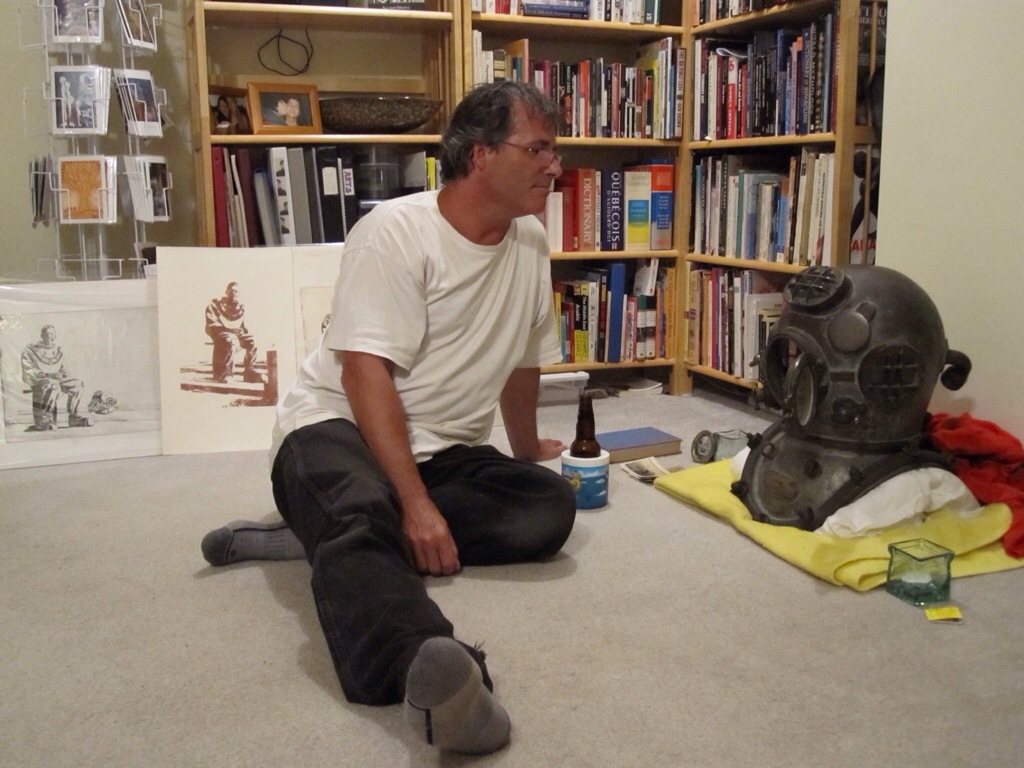
At the moment he is propped up on a pillow and blankets on the floor by my library shelves until we resolve the stand issue. Bert came down from Timmins in early September, and prior to his arrival I prepared a little shrine with photos, an old book our dad had made drawings in, candles, and a drape concealing the helmet so that he could take his time with the moment of unveiling. I had put a small LED light inside, and later we sat in the dark watching as a glow of colour gently changed from red to orange, green to aqua blue, indigo to violet, and back to red again. It was so perfect and beautiful!

Dad will be travelling to Timmins (his birthplace), where the plan is that he will spend a length of quality time with each of my brothers. As for me, the events of last year have had a life-altering effect. Many positive changes have occurred, but most importantly, I made the decision to move to Windsor to be closer to family. There is much catching up to do. What an exciting time, and what a year it’s been!

20140308-010945.jpg